Showing posts with label Rajasthan Tourism. Show all posts

Monday, 5 October 2020

Battleground of Mewar - Haldi Ghati


In memory of Maharana Pratap of Mewar

Indian History had witnessed the reign of many rulers, many warriors, with some rulers who focused on ethical rule, some rulers focused on heavy warfare to increase dominance, some rulers were known for civil well-being but there are many who are known only for cruelty and destruction. Folklore and local stories carried forward many stories of siege, sacrifice, friendship and many colors of life.The place I will be taking you to have witnessed the battle of two of the greatest rulers our motherland has seen. 

Haldi-Ghati is a hill pass in the Aravali Range in the state of Rajasthan, which is 40 km from Udaipur. The access to the pass has a good road connectivity but the roads are slim. The name is derived from the yellowish tint of the soil in the area. The place got its name inscribed in history due to the ferocious Battle of Haldighati of 1576 which was fought between Maharana Pratap of Mewar and army of Mughal emperor Akbar which was commanded by Man Singh I of Amer. During this tour, I will recite certain parts of the battle and stories related to it, based on the monument we will be visiting. 
 
Let's take this beautiful journey into our history.

Things to Explore

I. Main Attraction

1. The Narrow pass of Haldighati

Presently it is a small hill pass through which road is built connecting Khamnor and Haldighati. The soil around the area has a yellow tinge like turmeric giving a golden feel, and reason for the name. A picture in that area is must have in your collection. 

The rocks around Haldighati pass

2. Roses of Haldighati

The valley of Haldighati is known for "Chaitri Roses". As per folklore, it is said that the breed of rose was brought in by Mughal soldiers in the area, and it adapted well in that soil. These roses have a pink tinge, bloom in plenty in the month of March-April, corresponding to Hindu month "Chaitra", which falls in April, giving the name. There are many rose product industries in the area which makes Rose Water, Gulkand (rose jams), and perfumes. 

It is said that the blooms of Chaitra Roses and Sandalwood trees around the area is nature's way to give respect to the brave soldiers, whose blood got mixed in this heroic land.

II. Monuments and Gardens

1. Rakht-Talai 

It is a garden memorial dedicated to all the lost lives in the war irrespective of which side they were. It is said that around 25000 members of Mewar army was standing against colossal army of 2.5 Lakhs Mughals. Being a hilly terrain, Maharana took help from archers and cavalry of local tribes and villages in the battle. Maharana Pratap was supported by Hakim Khan of Suri Dynasty, Bhim Singh of Dodia, Ramdas Rathore, Bida Mana and his men of Jhala clan of Rajputs. 

Taking advantage of the hilly battleground, the army of Maharana was dominant over Mughal army as they struggled in hilly passes. The battle saw huge bloodshed with bodies scrambled all around the area. It is said in folklore that it rained heavily, which washed all the blood and a lake of blood was formed, so the name Rakht-Talai is given to the place. The garden memorial is constructed around the area. 

Garden of Rakht Talai


2. Chetak Smarak

Chetak, the name of the loyal war horse used by Maharana Pratap, and supported him in all battles, till Haldighati. As per folklore, in Battle of Haldighati, when Maharana Pratap got heavily wounded, Bida Mana, with permission of Maharana wears the royal crown and flag of Rajputs claiming to be Rana himself, attacked the enemy so give time, to help Maharana Pratap escape. It is said that a wounded Chetak carried the wounded Maharana, jumped across 21 feet wide river and escaped out of the battle field saving Rana's life. But unfortunately, Chetak lost his life. The memorial is supposed to be at the site, where Chetak took his last breathe. 

The memorial of Chetak

3. Maharana Pratap Gufa

It is said that Maharana Pratap, pledged to free Mewar from the Mughals, and he left the comfort of palaces and stayed in forest. He converted a cave into his training area and performed all war practices with the help of local tribes. The cave is said to have three entry paths, which are confusing and not properly visible from outside. During his stay here, his wife and children and his loyal Chetak was also there with him. The cave was used for religious prayers, stock piling all arsenals, lived on simple forest foods and practiced war training. 

4. Maharana Pratap Memorial and Museum

The museum is built by Mohan Lal Shrimali, who was born in Haldi-ghati and was a teacher by profession. His desires to showcase the story, learning from the life of Maharana, his sacrifice and bravery led to the creation of this amazing setup. It is a must visit in Haldighati as here you can easily learn the complete history of Mewar and life lessons of Maharana Pratap. The museum hosts a show on Maharana's Life through a video and audio journey using idol in a very enchanting way. 

The bronze model of Haldighati was scene

5. Maharana Pratap Monument

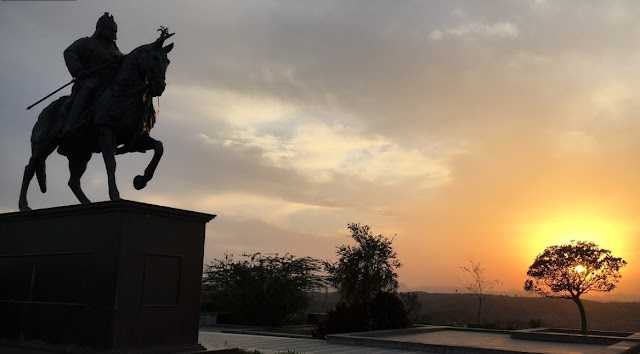
A site well developed by Rajasthan tourism to celebrate the victories and honor of the great ruler of Mewar, Maharana Pratap. The statue of Maharana Pratap riding Chetak is decorated on small hill which can be accessed easily through a well built stairs. The place gives a beautiful sight for visitors and photographers to enjoy the scenes of surrounding area.  

The memorial of the great Mewar King "Maharana Pratap"

6. Shahi Bagh or Badshah Bagh

A beautiful garden which is a good place for children and picnic. The story of the area is that during battle of Haldighati, the pass was small, so only a small troop can pass through it. So, on the other side, the large Mughal army settled in this area, that is why it is also named as Badshah Bagh. This is the area where the first encounter between Rana's army and Mughals took place leading to stampede and death of many Mughal men. The area around the garden is really beautiful and well maintained by tourism department. 

The gardens in Shahi Bagh

7. Rajtilak Sthal (Place where Maharana was Crowned as King)

Gogunda was former capitol of Mewar. Rajtilak of Maharana Pratap was completed by Masaliya Rawal, who was the Rajpurohit of Jhala Rajput.The place is presently marked with a small mast of Maharana and a small Mahadev temple is built. 

The place where Maharana Pratap was declared as King of Mewar

How to Reach

The place is hill pass is near Nathdwar, in Rajasamand District. The nearest railway station is Udaipur, which is at a distance of 40km. It is well connected to most part of India. The roads are very good around the area, except for the hilly passes of Haldighati in Aravali, which is good but thin.  The nearest airport is also at Udaipur. 

Road through Haldighati Pass

Where to Stay

I will not suggest any stay options at Haldighati. Instead you can opt for either Udaipur or Nathdwar. If you want a scenic stay, select Udaipur, else if you want to have a religious visit to Shrinathji Temple, then stay at Nathdwar.

Who Should Visit

Strictly for history lovers and those who appreciate bravery of Indian rulers . Others, Stay away.

No. of Days

Haldighati can be covered in day drive through the ghat.

Battle scene of Haldighati - Oil painting by Chaturbhuj and Sons, Udaipur (1935)


The Battle of Haldighati witnessed massive killing of men from both sides. The battle was so brutally fought that the land was eroded by bloody waters. The history of this area is made famous through tales and folklore. The result of the war is unclear, with most references telling that Akbar won the battle, but the heavy loss of Mughal army made it pretty clear that the dominance of Mughals in the area weakened, with many proofs showing an established Mewar activities. It is very clear that, post the battle of Haldighati, Maharana Pratap, reinforced his military and made the lands of Mewar free from of dominance of Mughals. 
 
War scene painting - Maharana Pratap attacking enemy (Maharana Pratap Museum, Haldighati)

India has many stories of leadership and bravery spread across the land, but as a traveler you need to take the difficult roads to reach these places and learn about the stories and create a picture of the reality with believes on the tales and folklore, which still remains as a major form of information exchange regarding the history. The magical resemblance of the stories with the real world landmarks and monuments, makes you appreciate the ways these historic happenings have traveled from tribal songs to books and finally to the articles in google. 

Here, I would like to drop my point of view for all travelers, "Don't believe in my story, Go the distance, Witness yourself and Tell your story", because History is True and Unchangeable, and there is nothing that can change it. 

Happy Traveling !

Sunday, 13 September 2020

The Citadel of Power - Chittorgarh


The massive Fort of Chittorgarh
 

Indian history has many stories of Heroics, Bravery, Patriotism, Faith and Love. The Rajputs of Rajasthan is well known for their strengths, valor and extreme dedication to their motherland, and to prove that there are many historical incidents recorded in time. Indian history has witnessed infinite moments where the result of war is so traumatic that their are no winners and losers. The only thing survived was massacre and bloodshed. Along with such heroics, forts are center of culture and architecture. Indian Architecture shows remarkable proofs that India is blessed with amazing artisans and craftsman. 
 
In our journey, Let me take you to such an auspicious fortress, that is a living example of heroics and architecture of ancient India.  
 
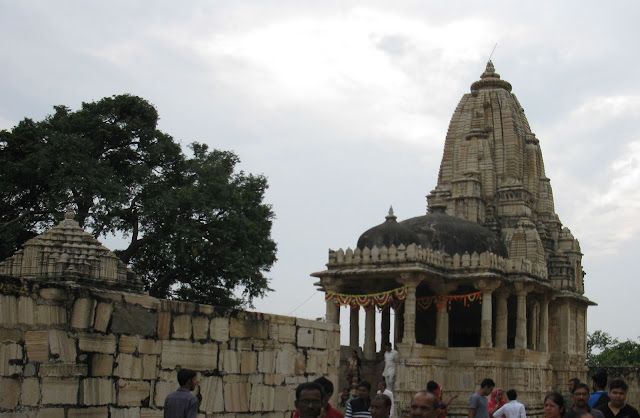
Chittorgarh Fort, is notably the largest fort in India, which is spread across an area of 692 acres and it is built on a hill top of 180m. The fort has huge walls and gates. The fort itself is a self sustained town with Palaces, water tanks, temples and many architectural constructions.The fort was said to be first constructed by Chitrangada Maurya. Later, many rulers of different dynasties ruled the fort including Merwar rulers, Sisodias, Khiljis, and even Mughals. The view of the grandness of the fort will easily make you understand, why different kings kept fighting to capture the fort.  Many constructions are still as gorgeous as they were in their youthful times.
 

Places to Visit
 
 
1. Pols (gates) of Chittor Fort: The entry to the fort takes you through seven marvelous gates or pol, as called locally. The Padan Pol is the first entry to the fort. The second one is Bhairon Pol, is named after a brave soldier Bhairon Das who died in battle at the spot. The third gate is Hanuman Pol and fourth gate is Ganesh Pol. Next is Jodala Pol, marked by a sharp turn towards the next gate, Laxman Pol. The seventh and the gateway entry to fort area is Ram Pol

Jodala Pol (left) taking to Laxman Pol
 
2. Kumbhshyam Temple of Meera Bai
Meera Bai is known for her devotion towards Shri Krishna. It is said that this temple is built on the request of Meera Bai. In the later times, a temple dedicated to Meera Bai and another for Swami Ravidas is also erected in the complex. 

3. Kumbha Palace
As per various historical records, the palace was properly built by Bappa Rawal in 734AD. The same palace was used and developed by Rana Kumbha
 
Temple dedicated to Meera Bai beside Kumbhshyam Temple

 
4. Jain Swethamber Temple and other Jain temples
All temples dedicated to Jain tirthakaras in the fort are examples of beautiful stone work. In total, 6 structurally stable Jain temples are present. 
 
5. Samadhisvara Temple and Gaumukh Kund
A temple dedicated to Shiva and is a beautiful structure. The most attractive part of the temple is the view of the Gau Mukh Kund and surrounding which is sensational. 

6. Jouhar Kund 
It is supposedly the place where an act of mass self immolation took place during the reign of Ratnasimha. According to the epic poem, Padmavat, his defeat against the invading Khiljis trigger the suicides of Queen Padmini and the women of the town to avoid enslavement. Presently, the well is filled with soil and is basically a grassy garden.  
 
Jowhar Kund turned Grassy Garden


7. Vijay Stambh
A symbol of victory that was constructed by Rana Kumbha, when he successfully recaptured chittorgarh in 1448. It is probably the most beautifully carved structure on the fort.
 
8. Padmini Mahal and Jal Mahal
A beautiful building preferably used by Rawal Ratan Singh and Rani Padmini. A beautiful garden areas. A Jal Mahal was also constructed in the lake beside the palace.

Jal Mahal beside the Padmini Palace

9. Kirti Stambh near
Shri Digamber Jain Adinath Temple
The construction of this 22m tower is funded by a Jain merchant. The structure is very beautiful. The stambh is placed beside a beautiful jain temple dedicated to Rishabhanatha Tirthankar.  

10. Rana Ratan Palace 
Maharana Ratan Singh II, son of Rana Sanga ruled from 1527 to 1531. He constructed this beautiful palace as a winter stay. The Ratneswar Mahadeva Temple exists inside the palace. It has a rectangular layout with high walls. It houses many courtyards, towers. It also comprise of amazing gardens. A must visit.
 
Rana Ratan Singh Palace

 11.
Bhimlat Kund
A water tank that was supposed to come into existence when Bhima, from Mahabharat hit the ground. It is a deep water body.   
 
Bhimlat Kund

12. Suraj Pol 
A beautiful gate on the east side of fort. The name is derived from the fact that it faces the rising Sun. You can see a hill from here known as Kumbhakaran Hill as it resembles a sleeping body.

View of Kumbhakaran Hill from Suraj Pole
 
This is just the major list of iconic building and travel spots to cover in Chittorgarh Fort. If you have a nack towards history, then every wall, every fallen stone of ruined building has a stroy to tell you and it is completely on you to understand it. 
 
 
How to Reach this Place:
The nearest big cities are Udaipur (west) which is 70 km and Bundi / Kota (east) is 173km from the town. The roads are good and scenic. Chittorgarh has a busy railway station, which is connected to important cities like Udaipur, Jaipur, Bundi, Jodhpur, Indore, Delhi, Bhopal and many others. Udaipur is also the nearest Airport.  
Taking about Prices: Train journey from Delhi may cost you Rs 1200 - 1500/-. A bus journey from Udaipur will cost you Rs 500 - 1000/- depends on the bus type and travels used.
 
 
Visit Schedule:
The Chittorgarh fort remains closed on Fridays. It Open from 9:45am in the morning till 5:45pm in the evening. I would recommend that you should hire a tour guide to help you with the stories. If you ask, where to find the tour guide, so you don't worry they will find you. Mostly all tour guides are seated near the ticket counter of Chittorgarh fort. 

Details of Entry Ticket

 
Where to Stay
Being a tourist spot, there are lots of stay options but very few eating options. Most stay option are middle to low rated areas. A few worth mentioning are Hotel Pratap Palace, Padmavati Fort View, Kumbha Retreat and many others. But, those who prefer posh living, opt to stay at Udaipur instead. 

Who Should Visit
It is very simple, a traveler who can imagine the grandeur of a ruined fort and acknowledge architectural achievements, should only visit Chittorgarh. You should appreciate the talent of artisans who have created these marvels. 

Who Should Not Visit
People who lacks appreciation of Indian history, heritage monuments and those who only prefer ultra modern constructions of foreign countries, should stay away because these monuments don't deserve any vocal miss-treatment. 
 
No of Days required: 1 Night -2 Days 

-----------------------
 
Our history is about stories of bravery and sacrifice. So to end this visit, I will recite two well known happening related to Chittorgarh.
 
Panna Dai and her Sacrifice:
The story of Panna Dai's sacrifice dates to the time of Maharana Uday Singh II ( father of Maharana Pratap). Panna Dai was in-charge of well being of infant Uday Singh II. Due to uncertain political issues, and disorder caused the then ruler, Vikramaditya II, he was arrested and Bhanbir, distant cousin of Uday singh was appointed as ruler of Mewar. But he acted against all, to declare him as the original king of Mewar. To achieve this he killed every possible competitor. When he was going to murder infant Uday Singh II, Panna Dai exchanged him with her own son and with the help of trusted maids, she safely shifted Uday Singh II to Kumhalgarh area. The saddest thing, while her son was brutally murdered by Bhanbir, she stood their watching the incident.   
 
Mass Self-Immolation by Rajput Women
Indian history has seen many cases of Jauhar, where royal queen with group of other women commit suicide by walking into flames. As said by historians, Chittorgarh witnessed two of the biggest Jauhar incidents. The first one by Rani Padmini, when the reigning Rana Ratan Singh faced defeat in battle. The second one by Rani Karnavati, when the reigning Rana Sanga faced defeat.  
 

The walls of every architectural marvels in India shouts out loud, numerous stories witnessed by the walls, and if "Walls have Ears" then walls will tell stories of nationalism, bravery and dedication that may consume the whole life of a human. So, to understand yourself, you should go into your history and experience it. Chittorgarh  is a very beautiful fort and as an Indian, I will recommend every reader to visit this site once in your lifetime.

Happy Traveling !

Saturday, 5 September 2020

Jaisalmer — A Golden Safari

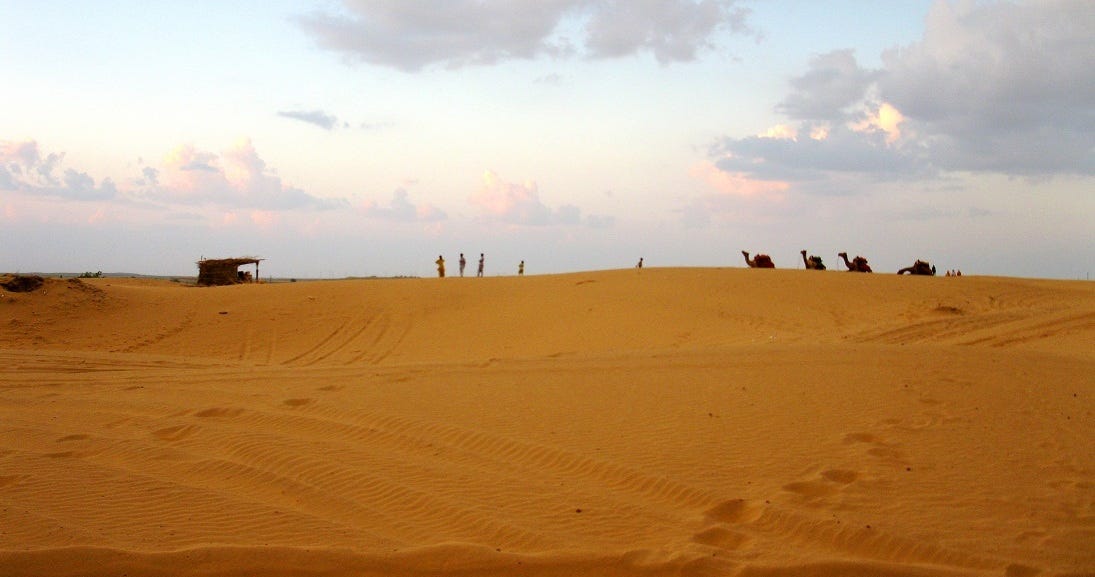
      Sand dunes of Thar Desert

The magnificent Thar Desert

Image for post
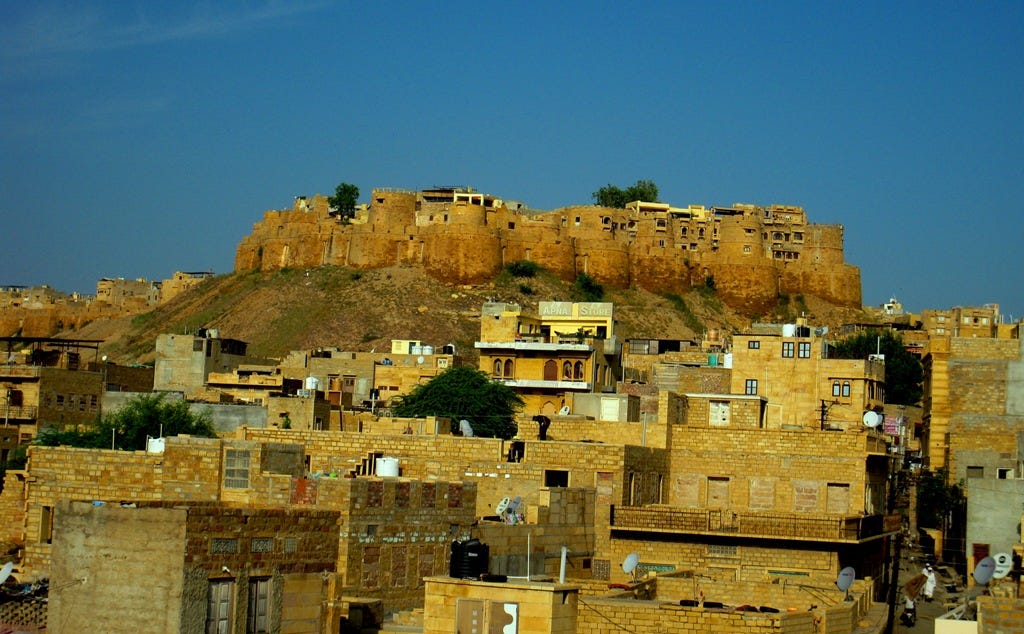
The Astonishing “Sonar Killa”

Image for post
Gadisar Lake (left) Patwon ki Haweli (right)

Image for post
Kuldhara Village (Left) Sam Sand Dunes Desert Camp (Right)

Image for post
Fateh ki Kachori (left) Bhatia Sweet Shop (Right)

Image for post
Mr. Barkat from Hotel Haveli, the man who made this trip a perfect happy family trip